
Why do Players Skip?
Getting back to the action

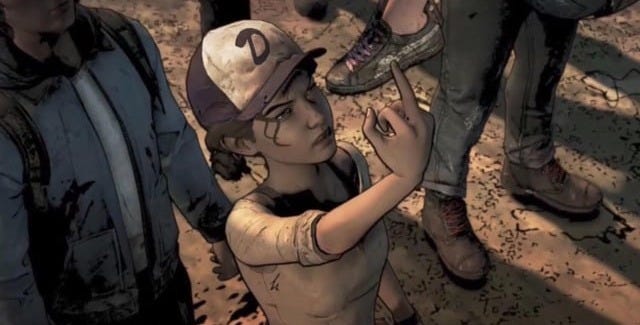
It’s the classic bane of game writers: players who skip.
Through the history of gaming, there have always been some portion of players who skip. Sometimes they’ll skip through long-winded dialogue scenes, like a distracted app user acknowledging terms and conditions. Some players regularly skip through cutscenes, especially if they’ve already seen them before. Hell, even the most dedicated of us sometimes skip to advance a line of dialogue when we’re reading faster than the voice actor’s delivery.
The exact percentage of players who routinely skip dialogue and cutscenes varies with the situation, but it’s significant. And in gamedev, where cutscenes and performance capture and voice acting are high-cost line items on a game’s budget, it can be a punch in the gut to see players skip it with the press of a button.
I’ve seen different studios try a variety of options to mitigate this. Everything from requiring extended or repeated button presses, to changing “skip” to “fast forward”, to outright forbidding players from skipping a cutscene the first time they see it.
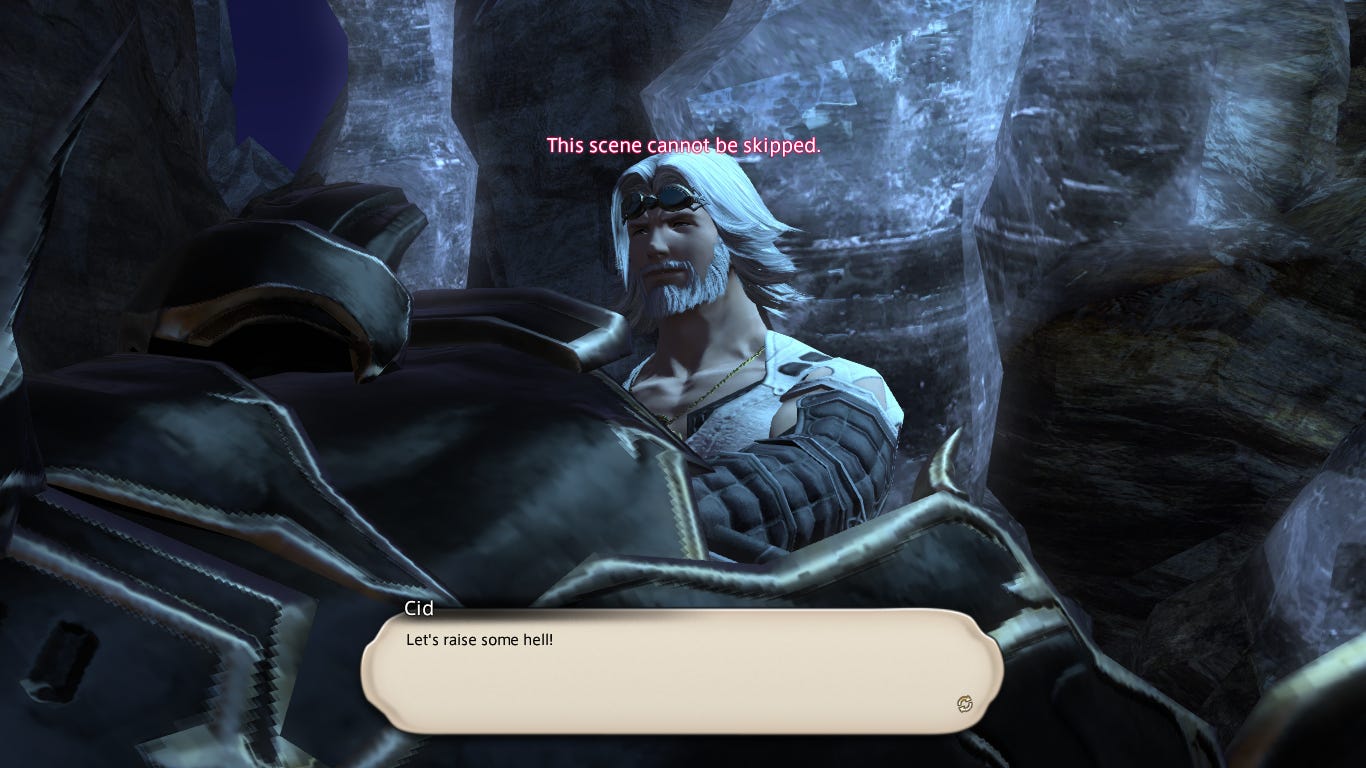
Hell, at one particularly cinematic project I worked on, there was a mandate from directors: all cutscenes should involve some big change to the setup that significantly changes a player’s situation, so that players who skipped the cutscene should be confused about what they missed. The idea was explicitly to punish players for skipping.
Obviously, that decision did not survive to launch. But the frustration is real.
You don’t see this happen with movies or TV shows: nobody watches a new show while skipping ahead 3 seconds at a time as they read ahead on the subtitles. And while people do listen to audiobooks and podcasts at increased speed, it’s rare for anyone who actually wants to experience the media to skip through entire chunks at a time. This is a phenomenon unique to interactive media.
So why do players skip? And can we do anything to convince them not to do it so often?
The Case for Skipping
Sometimes, it’s easy to understand.
Sometimes you’ve got a cutscene you have to wade through repeatedly, like one that introduces a tough boss every time you respawn to fight them.
Occasionally you’ve got a conversation that’s just too wordy, or a dialogue tree that’s constantly cycling back to the same repeated phrases.
And every once in a while, you’ve just got a vocal performance that’s way too slow compared to the subtitles, but without a presence or visual aspect that helps maintain players’ attention.

These are cases where skipping feels justified because the design or writing or performance clearly isn’t respecting the player’s time. And in game design, disrespecting the player’s time is a breach of the implicit promise you make to the player.
But those are far from the only times players skip. Whether it’s skipping big cutscenes or rushing through dialogue, it’s not always so clearly justifiable.
But if you ask those players, you usually get the same response: “I just want to get back to the action.”
Getting to the Action
A brief technical aside about measuring “action” in a game.
The most common measurement for action is the clearly named “Action Per Minute” measurement — a fairly straightforward measure of how many individual button clicks, mouse or joystick movements, or other individual input actions the player performs every sixty seconds in your game. This isn’t a continuous pace, of course, and there are ranges between high- and low-intensity periods of play, but it’s a good measurement of general pace the player is expecting.
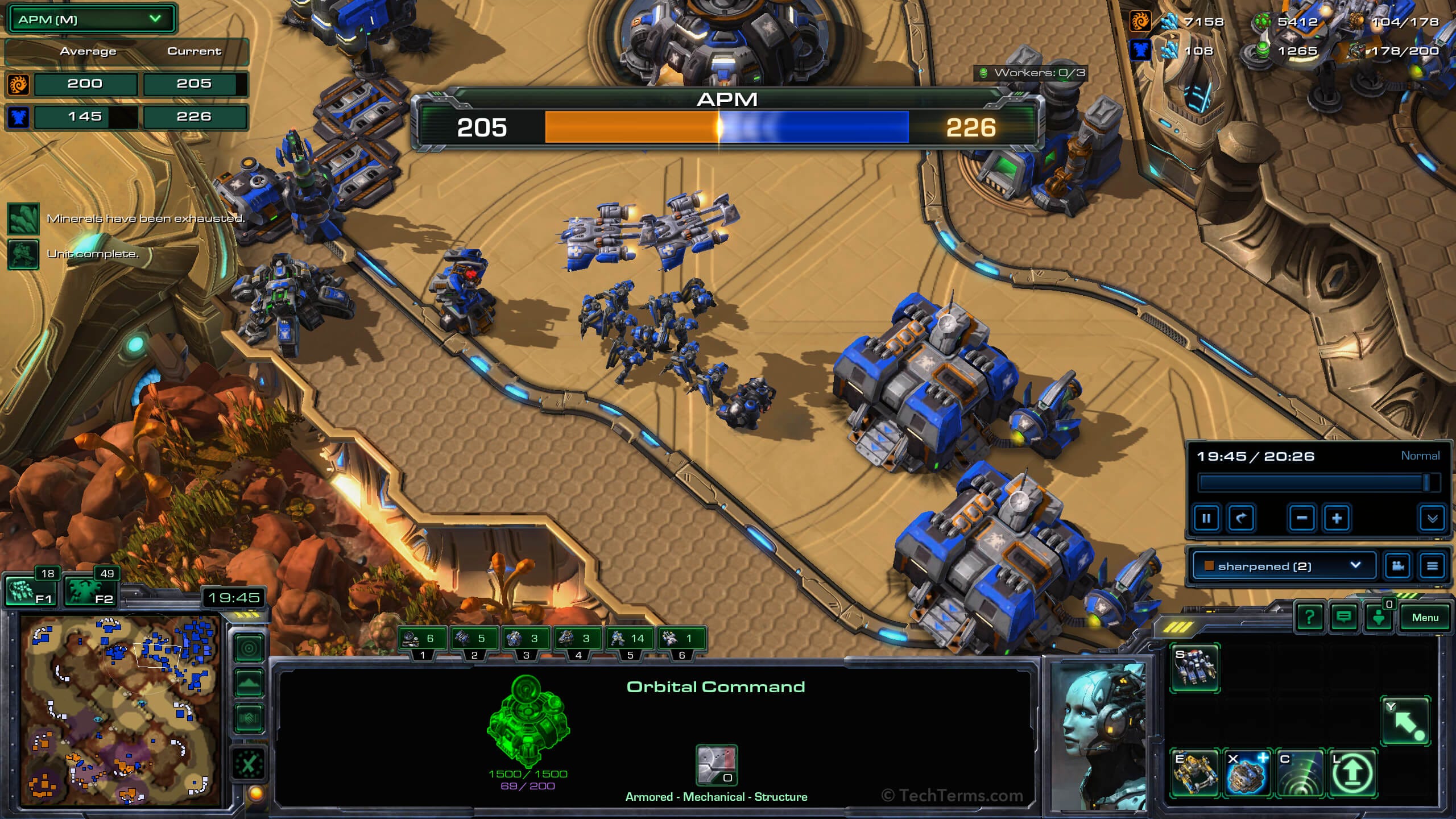
This number scales wildly based on the type of game, naturally. For a professional Starcraft II player, you’re looking at 300+ APM just to be considered competitive. Modern fighting games tend towards 100-150 APM. Super Mario Brothers clocks in at about 60-100 APM. World of Warcraft is closer to 40–90 APM, with the low-ends involving classes that are considered downright lazy by many players’ standards.
Anything with a lower APM than that is usually considered a “low-action game” — such as a turn-based or strategy game, particularly ones with little or no time pressure. Such games are rarely measured by APM, but it’s still worth considering similar cases. Most speed chess formats average about 15 Actions Per Minute. Official fast chess matches tend towards 1-6 APM. And the classic “full-length competitive grandmaster chess matches” can go as long as ~50 moves over 2 hours per player, or less than 0.25 APM.
A pre-rendered cutscene has 0 Actions Per Minute. it might as well be a loading screen.
…Unless you skip it, of course, since that’s the only action you can take.
Skip it fast enough, and you might even get back to the action in time to maintain a fairly steady APM and keep up your gameplay momentum.
How Slow is Too Slow?
And that makes sense when you look at how conversations play compared to most other gameplay.
Just out of curiosity, I loaded up a random let’s play of Baldur’s Gate 3 to check how long a fairly standard (but significant) conversation takes between choices. Not counting dice rolls, here are the tallies for a single, directed (as in, not a “explore my entire conversation tree while returning to the hub”) conversation with Raphael in Act 2:
Here’s a tally of the time spent passively watching a performance between making choices on the conversation tree:
2:40:03-2:40:27 (24 sec)
2:40:32-2:40:42 (10 sec)
2:40:46-2:41:05 (19 sec)
2:41:11-2:41:24 (13 sec)
2:41:25-2:41:53 (28 sec)
2:42:02-2:42:34 (32 sec)
2:42:41-2:43:01 (20 sec)
2:43:08-2:44:06 (58 sec (!))
Some of those are nice and short interplays. Some of those would be long even for Bethesda’s old standards (we rarely liked more than three lines of dialogue between the player getting to make a choice). And that last sequence, if it were a loading screen, would almost be a violation of the rules you need to meet for various game system certifications. And they all have just about as much player interaction as loading screens.
Specifically, this is a total of 8 actions made over the course of 4 minutes, or an APM of 2. Now that’s not a huge slowdown for a turn-based game like Baldur’s Gate 3, where you’re already going to be puzzling over moves in tactical combat. But in an action game, it’d be like hitting a brick wall -- and there are plenty of action-ish games that have conversations like these, except they tend to be less well-written or realized.
Turn-Based Conversations
These sorts of conversations are a legacy of RPG and adventure game tradition that’s never really been questioned since then — I call them “turn-based conversations”, because they follow the same general experience as the old turn-based RPGs: you pick your choice, you see how it plays out, you wait for the other person’s response, and then you’re back to picking your next tactical option based on your assessment of the conversational partner and your goals.
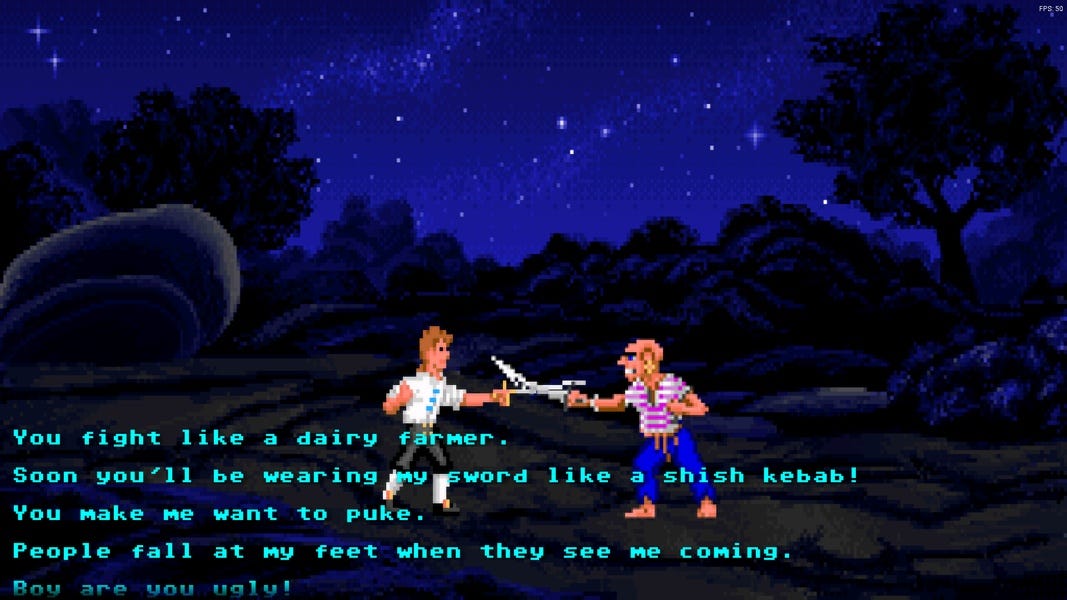
That’s fine for games that are already slow and deliberative, but it’s a huge speed bump for more active games. What’s more, it’s a pretty poor interpretation of how real-life conversations flow, with their nuanced variety of non-verbal cues and responses and interruptions.
If you wanted to more realistic conversations, you’d need gameplay during conversation that allows players to be more active at their own pace during conversations. Something more robust and systemic than simply picking from a handful of scripted responses, even if you’re still traversing through same scripted tree. Something where your character’s personality is reflected not just in the words they say, but in the actions and attitudes they perform during the conversation. And all of that would mean conversations that have a higher APM than a game of chess.
What might that look like? Well, let’s talk about that next time…
I think people probably skip because they want to play a video game. If they wanted to watch a movie they would have put a movie on.
I liked this and im guilty of skipping, but mainly if ive seen it before or if story didnt catch my attention in the first 3ish cutscenes before..
The ffxiv screenshot looks like that one story mission that is part of the daily roulette, which no longer allows u to skip the cutscenes because it makes that entire dungeon like less than 2 min if i remember correctly 😅
But having to watch makes it sit at like 10 min or something.. i dunno, i havent played in a long time. All i know is that the cutscenes in that specific mission are long enough for you to go to the bathroom, make a hot pocket, move your character to the next room, another cutscene to cool your food and eat it before the boss fight. 😅
If its any consolation to game creators, i always watch end credits 💖